Showing posts with label Shibori. Show all posts

May 18, 2015

Blog Book and More

The blog book I ordered has arrived. I've been trying to come up with an idea how to print my blog. Both Mr Notjustnat and I came up with various ways, but in the end I decided to get it printed with Blog2Print. I decided to print one year at a time. My first book for the 2014 posts has arrived. The next one is ordered and it is on its way. I'm very happy with how it looks and feels. The photos are as clear as I see on the web. 

Apart from that, I had a busy couple of weeks yet again. I visited a great exhibition: Exquisite Threads, English Embroidery 1600-1900s. I took some photos of my favourite pieces to share with you here.

I was sick for most of last week. The doctor ordered for me to stay home during that time. No good giving my cold to the rest of the team at work! The weather was horrible the whole time I was home, but I managed to complete small sewing projects and put on a batch of dye during that time.

My first blog book for 2014

2014 when I went on a textile trip to Vientiane
Luang Prabang and Siem Reap.

Below are some photos of the embroideries at the Exquisite Threads Exhibition. The first one is a Bible cover from the early 17th century. What caught my attention was the work of free-form embroidery. To use it for a Bible cover was comforting to me because I'm making the same things, but for journal covers.  

Bible cover-early 17th century

Part of my hand-stitched journal cover

My 2015 travel journal cover

Coif - early 17th century. Linen, silk, gilt-metal
(thread, spangles)

Section of a larger embroidery panel 

Stomacher - early 18th century

Below are a few small projects I worked on while I was home sick:

Shibori stitched on linen dress, socks and
cotton threads ready for indigo dye

Quilt label for Red Star and Blue Sea
quilt posted here

The Civil War block I made using Barbara
Brackman's free patterns that I posted here 

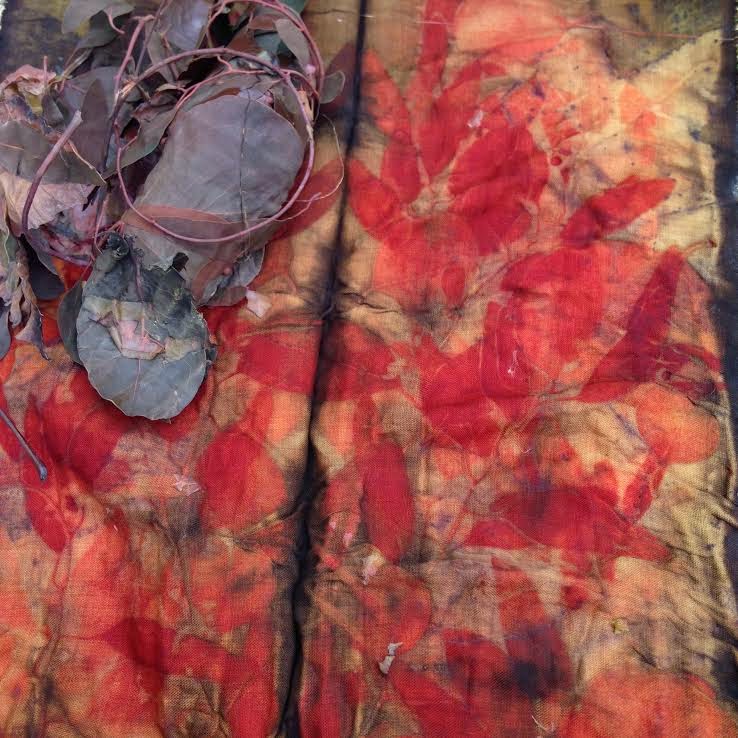
I was given walnut hulls a couple of weeks ago. I soaked them until they were ready to be used. Steeping is another way to cook dye bundles. The liquid you steep bundles in could be anything from natural sources. All bundles for this batch had been steeped in walnut bath. 

Jars and bundles ready to be opened

Unwrapped bundle of wool and Eucalyptus

A peak into another bundle of silk and Eucalyptus

Another bundle using different Eucalyptus

Autumn maple leaves on vintage silk

Silk scarf dyed in walnut bath
Lucky find:

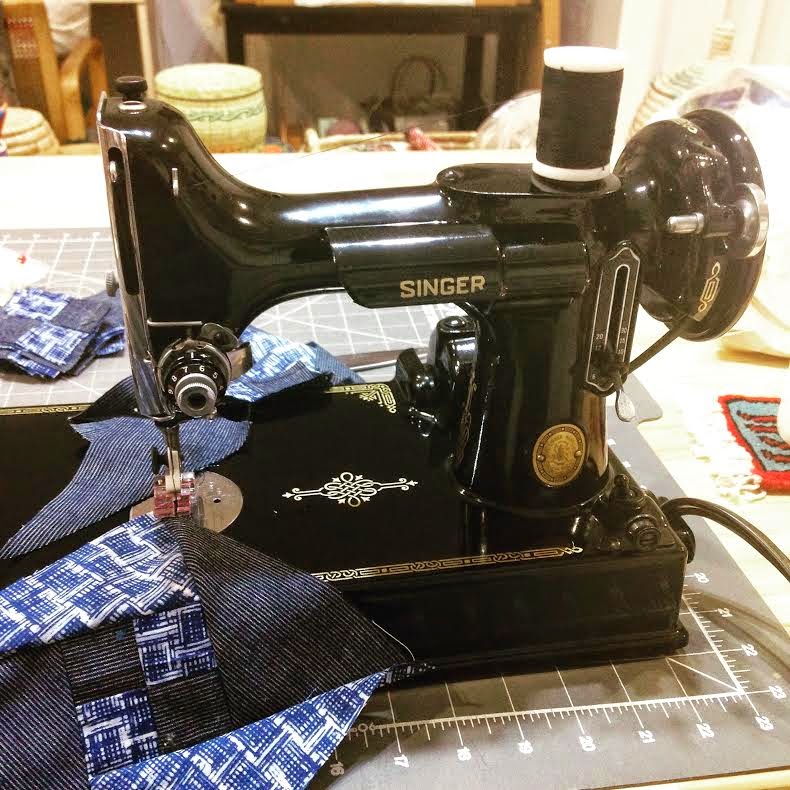
My sweet Abela

A lucky find for this post is not what I found recently, but it was a lucky find I found 15 years ago on eBay. This sweet Singer Featherweight is my proud and joy and I enjoy her every time I sew with her. I only use her to sew vintage fabric. I named her Abela to remind me of an Arabic name for a beautiful little girl. Abela was made in Scotland, but I got her from Texas, USA. 

Until next time
Nat

June 30, 2011

Arimatsu Shibori Festival

Arimatsu Shibori Festival was one of the highlights of my trip to Japan. The festival happens annually on the first weekend in June. It was luck or good planning as it happens that my friend Ayako and I were on our way to Tokyo that weekend. We stopped in Nagoya which is only 25 minutes by local train to Arimatsu. We stayed for two nights in a ryokan. I thought I knew a lot about Shibori and even took a workshop on Shibori techniques, but what I saw at the festival was amazing! As soon as we stepped out from the train station we saw the street lined with every kind of Shibori from children outfits, umbrellas, hats, shirts, fabric, kimonos etc... I spent both days at the festival and enjoyed every minute of my visit there. 

They were demonstrations of different Shibori techniques by the lovely ladies, the same ladies I saw on a YouTube video. It was exciting to see their work in person! For a small fee you can make Shibori yourself and dye it right there. Both indigo and natural dyes were available for us to use. 


On my second day I came across these adorable boys enjoying the icy crust on the side of the road. I asked their mother permission for a photo. You got to love them in Shibori outfits. How very cute!


The map of the Festival was posted at the beginning of the street. It's mainly one long street with lanes going off each side. You have to be so careful not to miss any of the activities that are there. 


It was a very hot day and everyone seemed to be queuing to buy umbrellas. No I didn't get one even though I was so hot that day! 


These are only some of the things made from Shibori fabric. The Shibori fabric used in clothing is very stylish. I love the jacket on the right. 


This stall sells all natural dye items dyed by the lady next to me. I only bought the one I was wearing. I would have bought everything from that stall if I had more $$$!


Abundant Shibori fabric for sale. You have to get the whole bundle when you buy. They do not cut them per yard at this shop.


Some kimono displayed in front of a famous house that once used to be a prime Shibori producer. 


I met Yoshiko Wada there. She is the author of the 'Shibori' book and the founder of World Shibori Network. She took a tour there. She is well known at the Festival. She asked if she knew me, I told her yes we are friends on 'facebook'! 


Rack full of Shibori garments. I did buy a very cool hat from there. I will show it off on my next post under shopping. 


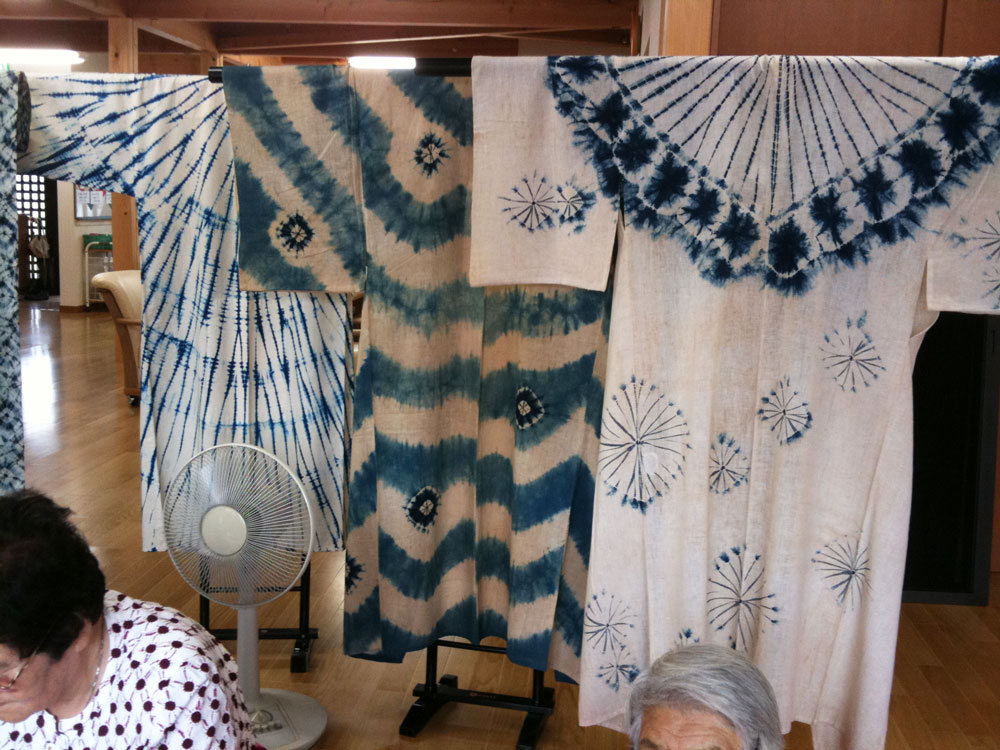
These were the show pieces being displayed at the Shibori Center where all the demonstrations were taking place. They were really gorgeous up close. 


I did say it was a hot day. I normally carry a hat, but silly me, I've left it in my luggage at the hotel so the Shibori scarf came in handy as a head scarf! With me is Shizuka Ayako's friend from Melbourne. Shizuka now lives in Hiroshima. 


I want to show you this photo of the lovely lady tying the Shibori at the speed of lightning! Can you see how my camera couldn't focus on her hand, because her hands were moving so fast! 


This little stall tucked away almost at the end of the street was the place I bought my Sakabukuro and boro pieces from. I went back to the Festival for a second day just to pick up the Sakabukuro she brought for me. I didn't have enough Japanese Yen, but she kindly accepted my Australian dollars for it. 


Here is more Shibori fabric on display at the various venues on the street.

If you ask me, was the trip to Arimatsu Shibori Festival worth it? Yes, it worth every cent I spent to get there. I cannot tell you how I felt just being there! Walking among the lovely crowd of people who love the same thing as I do 'Shibori'.  The Festival was well run and highly organized. Yes I will go back again next time I'm in Japan.  

I hope you have enjoyed reading my Japan journal so far. I'm glad I could share it with you. Reflecting on my visit in this blog freshens up my memory of everything I did there. 

I got a lovely compliment from a Japanese lady about my Japan journal. This is what she said: I read your blog.  It is well organized and it made me smile since I understood a lot.  I am very impressed the way you captured beauty of Japan. I'm so delighted to get such a compliment. 

Don't miss the next installment of my journal. It's going to be on 'shopping in Japan'....!


June 14, 2011

Blue Heaven

How was it, how was my trip to Japan? I can hear you are all asking! It was amazing trip. It was well worth the wait, the worry and anxiety. I'm glad I didn't cancel the trip. Many caring people were asking me how was the situation in Japan. I didn't notice anything different in the people. From what I saw on the television the people of Fukushima are well care for from the Japanese government. They are very brave and courageous people and they will come through this. Many of them were worried about me being there so soon after the disaster. 

I don't know where to begin. I thought the tour was amazing, but better things were yet to come. I will just have to blog whatever come into my mind. I will be talking about my trip for a long long time so hope you wouldn't get bore hearing about it. 

OK, my first post is about Blue Heaven. Blue in this case represents indigo blue. I had three chances to visit the indigo artists. First one was with the tour. The second one was arranged by my host family, and the last one I was invited. 


Can you imagine a better looking sitting room? A comfy chair with an indigo cloth thrown over the back! A book in your hand and you can spend the afternoon there. This is the sitting room in the Japanese Textile Workshops studio. 


These two pieces of Shibori were pre-prepared before we went to Someori-San indigo studio. I didn't know if we would get a chance for a dip in the vat (the cloth, not me), but I thought it wouldn't hurt taking a piece to try. The one on the left was mine and the right one was Ayako's (my Japanese friend). 


This is my piece of Shibori after I removed the threads. The colour gets lighter after it dries. 


Elizabeth (I met Elizabeth in an online workshop) and I had a chance to have our photo taken with Fumiko Sato-San. This beautiful energetic lady is a living indigo artist. We were welcome to her studio to see her dyeing in action. I was there as part of the tour. 


These fashionably indigo clothing were on displayed in Sato-San's studio. I didn't get any of the clothing, even though I wanted too! I did get some indigo pieces from her scrap basket. I bet you didn't notice me crushing the bag of scraps in the above photo? 


These are Sato-San indigo vats. They are her treasure. They have pride of place right in the middle of the studio! She has six of them going all the time. We were warned not to fall in. We would have been very blue if we did!


If you ask me what I did most on my trip? I would say I smiled a lot until my cheeks hurt. Ayako told me I was having a party in my sleep! Here I was wearing a real BORO jacket. It was in perfect condition and on my back was a farmer's rain coat made from hessian (I hope I'm right!). Behind me is an indigo vat. It has proud of place by the front door of the house!  


Ayako is kneading an indigo piece between each dye. I have a feeling that she was every happy dyeing too! 


This lady is a student of English, but that day her English lesson was playing dyeing with us. She really enjoyed herself. Wouldn't you be with a result like that!


Bryan the owner of Japanese Textile Workshops was helping us unfold our pieces. He said this is what he likes best. Seeing the result of each Shibori after it is dyed. 


This one is my piece. We got to do two pieces that day. How generous of him! Each of the pieces is long enough for a scarf. I learnt how to fold this pattern that day too.

Let me tell you a bit about my experience with BORO. I have often used this word in my blog.  But this term is seldom used in Japan. It's a forbidden word. BORO means rag, clothing of the very poor farmers. It reminds the Japanes of a sad past in feudal times. 

There I was proudly showing off my BORO patches on my jacket to everyone. I was looked at strangely when I did that. People who know me know that I love vintage clothing and re-purposing my clothes. Today even the Duchess of Cambridge is called a thrifty princes. I just thought I would share with you the meaning of BORO and why the Japanese do not like to use it.


Related Posts Plugin for WordPress, Blogger...