Showing posts with label silk study tour. Show all posts

July 23, 2011

Japanese Hospitality

This is my last Japan Journal. It's going to be a little sad for me to stop writing about my wonderful trip to Japan. I cannot leave without telling you about Japanese hospitality. The Japanese take hospitality very seriously and they do it to perfection. I was totally humbled to get treated so well and looked after by everyone I visited. I read a little bit about Japanese hospitality in the journal Nipponia before I went this time so I took care to notice the way they go about doing things to serve you. I had the advantage to travel with Ayako, my student and friend. I asked her many questions about their culture in the two weeks we were together. 


Japan is a nation of gift giving. Giving is a strong part of Japanese culture. The history of giving goes back a long way in Japanese history. The art of Japanese wrapping and packaging we see and admire today is part of their giving culture. The gift giving culture is so strong that when you go shopping for gifts the shop assistant would packs extra bags with your purchase so when the time comes for you to give the gifts away you would have a fresh bag to put them in! I always admire my Japanese friends with their brand new bags and I thought, how do they keep the bags so fresh looking? Now I know! On the flip side of this I thought they must use so much raw material to produce so much gift packaging and bags, but the Japanese recycling system is the best in the world. More on Japanese recycling some other time...!


Sorry I went of subject here, but I feel that the art of giving is part of the Japanese hospitality. In this post I would like to  pay tribute to my host families for taking care of me, feeding me, taking me places and teaching me their crafts. 


If you stay at a Ryokan (Japanese Inn) you will be welcomed by the O-kami (Japanese Inn landlady) with a gracious smile. The moment the O-kami sees you she will be calculating your size in her head so she can give you the right yukata to use while you are staying there. 


This is an old Japanese home built from wood and paper lining. Japanese houses don't always have walls around them, but this one was quite close to town, and I think the walls help keep the passers by at bay. I just love the trees and bushes in Japan. Back at home I would have to visit a Japanese garden to see these trees, but here Japanese gardens are everywhere!


Once inside the genkan you must remove your shoes. It is best to arrange them with the toes facing the door. Most shoes were facing the right direction in the photo above. It pays to wear slip-on shoes when visiting Japanese homes. 


I had a chance to visit local artists Mr and Mrs Watanabe in Shiga prefecture. The husband and wife team. Mr Watanabe is a wood artist and Mrs Watanabe is a painter. They opened the house/studio to welcome me. They showed me around and by chance I spotted the photo of Fuji-San with the moon rising from behind. I thought it was a painting she did, but no it wasn't.  It was a real photo Mr Watanabe took himself on the last trip to Fuji-San. I was so entranced by that photo that I promised myself to go there and see the moon rise over Fuji-San in person one day! 


You might wander what this pile of fabric is. This pile of fabric is vintage kimono silk given to me by the artist above. She had them for so long and was happy to find a home for them. She did not only invite me to her home. She gave me something she knows I love and collected.


I stayed at the Hattas in Shiga for 5 days. Every day Tomiko-san arranged for me to visit  locals artists. I visited an indigo artist, an Italian cook, a graphic designer, a painter and on the fifth day we stayed home and visited Tomiko's pottery studio. Tomiko has been a potter for more than 30 years. She has  exhibitions twice a year in different cities in Japan. Every two years she and her artists friends put on an exhibition at their home. When I left, Tomiko gave me 6 pieces of her pottery. They are such treasures to me...


Everyone I met opened their home to me. I had Japanese tea and a tour at this beautiful cozy home.


I had a dip in the indigo vats in this old home. I can see now that he has ten indigo vats! Sadly Someori-San doesn't have anyone to inherit the indigo business after him. The indigo business has been in his family for the last 500 years. He will have to give it up when he is too old to manage it. 


I was taken to this country inn for lunch on our way to visit the Watanabe family. We had the most beautiful set meal. Only 20 sets are made per day. All the produce came from their own farm including eggs and milk. We had delicious sweet potato ice cream after lunch. 


I visited the private gallery of the Masuda family who are graphic designers. This couple makes modern art. They use modern technology to produce their work. They get a lot of commission work from private business. They are both cats lovers and have many cats. 


At the Japanese Textile Workshops I was shown how to wind silk yarn on the traditional  wheel. 


Here are Ayako (left) her sister Noriko and Katsu Noriko's husband. This young couple married two years ago. I knew them well from the wedding photos Ayako showed me. I also helped Ayako made their wedding journals. They are both very sweet. Both of them took a day off to take me out for a day. We went boating in the Tokyo river not too far from their home. The memorable experience for me would have to be the home style onsen (Japanese bath) I had every evening. Noriko here would run me a bath and just as I was about to enter the bathroom she stopped me and switched on the most relaxing music I have ever heard! 


Mr Hatta took us out to a Thai dinner on my last night in Tokyo. Noriko and Katsu found the most famous Thai restaurant in Rappongi (the nightlife district). I must tell you something about Katsu. Katsu at this moment is in London. He was sent by his company to select chocolate for next Valentines Day. He works for the Matsuzakaya Department store in Tokyo. Katsu was a football star in his youth and I suppose he knows what women like in chocolate!!! 


Last but not least, Tomiko and I at the sushi train restaurant. I had so much sashimi that night, they thought I would be sick the next day, but I wasn't.

I really enjoyed staying with the Hattas. They are an example of the best in Japanese hospitality. All good things have to come to the end. I have enjoyed reminiscing about my trip. Thank you so much for your comments and interest. 

My blog also reached 100,000 hits this week. I must say I'm very proud to get to where I am. When I started this blog just over two years ago I wouldn't have thought that anyone would read what I write. Blogging is like an indigo vat, you have to feed it to get the best result! 


July 15, 2011

Natural Dyes: Japan and After

I've read somewhere on India Flint's blog about dyeing on the move. Before I left for Japan I packed some vintage kimono silk to take with me to dye. I didn't expect to have the opportunity to do much dyeing on the trip, but I took it anyway. Sometime preparing is as much fun as the trip itself. In my case I had fun before, during and after the trip! Read on and you will see some of the dyeing I did on my trip. 

The first day on the tour we stopped at a small town called Kiryu in Gunma. Our guide told us about a small natural dye shop. In his opinion the shop was small, untidy and hippy-like, but when we arrived and met with the so called hippy who owns the shop I was speechless. He was so cool and full of character. In his excitement to have 18 foreigners mostly women in his small shop he told us about his natural dyeing process and how he discovered the way to stop the colour fading after it dyed. Of course we didn't understand a thing he said. We got it translated to us by the guide and I don't know how much was lost in translation!  


I didn't care what he said I was mesmerized by the man and his shop! It was small and untidy as I was told, but I like untidy shops. They mean bargain-able...! 


At home you would think these were spice jars. But these jars contain all kind of dye samples. Apart from the samples in the jars there were bags and bags of dyeing material all over the floor and when I had a peek behind the noren into the back room I found more bags of dye stuff there too. So cool!


This is part of his shop. He had an old weaving loom sitting right in the middle of the precious space of his shop. Lots and lots of handmade items and yarns for sale. The highlight for me would have to be the man himself! Oh, I did get some silk yarn for dyeing! 


When we visited the silk museum also in Gunma we had a chance to dye. The workshop was part of the silk museum. At home I have a dye pot in the corner of my laundry, but here there was a purpose-built kitchen for dyeing. The two stainless steel tables can be adjusted to suit your height. On one end of the table there was a sink with hot and cold running water and the cookers were at the other end of the room. In the photo above the teacher was telling us what to do (in Japanese).  


I was so busy dyeing during the workshop that I didn't get to take any action photos. Precious time dyeing with 17 other tour mates! Above is the result of our dyed scarves. The yellow and green one is mine. It was a two-step dyeing process. First in sappanwood (?) dye solution then shibori and dipped in iron or alum mordant to get the green or purple. We only had two choices of dyes that day. Pomegranate and sampanwood. 


I had a chance to have a photo taken with the lovely ladies volunteering that day. They were so lovely and polite. They didn't pull their hair out working with the noisy tourists. I would have...!


We had lunch with them afterward. All the volunteer ladies were specialized in different dyeing techniques. They were doing a lot of batik dyeing. This lovely lady was showing us a  beautiful scarf she made. She told me she dyed the silk dress she was wearing too. Very impressive.


Now for my dyeing adventure during the trip. It started off at the Narita Hilton. I used some used green tea bags provided in our room. I emptied two or three bags on the wet silk rolled up tightly with rubber bands and stored them in a Ziploc bag. All the other bundles consisted of leaves found along the way. I finally found white vinegar at a 7-eleven the following week. After that the bundle with vinegar did smell like pickles in the hotel room! These ziplock bags were in my luggage for 3 weeks and I had to unwrap and wash the silk before I left Japan. 


Here are the result of my dyed silk. They weren't brilliant, but I had fun in the process. I also kept my tour mates amused looking out for dyes stuff for me. One of them risk her life and steal mulberry leaves from Tomioka Silk Mill for me! I have a feeling that next time some of them travel they would be dyeing too! Thanks India for yet another expert tip on dyeing.


These are the silks I dyed since my return to Australia. You can see I was influenced by the Japanese dyeing method shibori. I love the soft colour I got.  From the left I used: privet berries, camellia flowers, more privet berries and the last one on the right is winter oak leaves with iron mordant. 


The first batch I dyed after my return. I got a bit of post Japan blues when I first got back so I dived into dyeing to get over my blues and it worked. I got grays instead of blues hehe! 


Mr Notjustnat was pruning the neighbor's bush coming over our wall. I didn't know what it was at the time. He told me I should try dyeing with them. I asked Mr Google what they were and got the answer right away that these are privet berries. 


I packed the berries between two layers of silk and smashed the berries to pulp. Rolled and steamed them for about an hour. The result is what you see above. 


The best natural dye session I did had to be indigo dyeing at the Japanese Textile Workshops. It still seemed like a dream to me that I was dyeing there. Indigo dye was the one thing I really wanted to do in Japan and my wish was granted just a few days before I left.  


Apart from the beautiful roses prominently placed at either side of the front door, the indigo  vat has a pride of place there as well. The same afternoon we were there one of Bryan's students was there to join in with indigo dyeing. I think she had much more fun dyeing and practicing her English with us than her usual lesson. 

My Japan journal is almost coming to the end. The next post will be the last of my Japan journal and it will be on Japanese hospitality. It's something close to my heart and I want to share it with you. Blogging about it is the way to thank everyone in Japan who went to great lengths to ensure that I had a good time while visiting their country.  Don't miss it!


June 30, 2011

Arimatsu Shibori Festival

Arimatsu Shibori Festival was one of the highlights of my trip to Japan. The festival happens annually on the first weekend in June. It was luck or good planning as it happens that my friend Ayako and I were on our way to Tokyo that weekend. We stopped in Nagoya which is only 25 minutes by local train to Arimatsu. We stayed for two nights in a ryokan. I thought I knew a lot about Shibori and even took a workshop on Shibori techniques, but what I saw at the festival was amazing! As soon as we stepped out from the train station we saw the street lined with every kind of Shibori from children outfits, umbrellas, hats, shirts, fabric, kimonos etc... I spent both days at the festival and enjoyed every minute of my visit there. 

They were demonstrations of different Shibori techniques by the lovely ladies, the same ladies I saw on a YouTube video. It was exciting to see their work in person! For a small fee you can make Shibori yourself and dye it right there. Both indigo and natural dyes were available for us to use. 


On my second day I came across these adorable boys enjoying the icy crust on the side of the road. I asked their mother permission for a photo. You got to love them in Shibori outfits. How very cute!


The map of the Festival was posted at the beginning of the street. It's mainly one long street with lanes going off each side. You have to be so careful not to miss any of the activities that are there. 


It was a very hot day and everyone seemed to be queuing to buy umbrellas. No I didn't get one even though I was so hot that day! 


These are only some of the things made from Shibori fabric. The Shibori fabric used in clothing is very stylish. I love the jacket on the right. 


This stall sells all natural dye items dyed by the lady next to me. I only bought the one I was wearing. I would have bought everything from that stall if I had more $$$!


Abundant Shibori fabric for sale. You have to get the whole bundle when you buy. They do not cut them per yard at this shop.


Some kimono displayed in front of a famous house that once used to be a prime Shibori producer. 


I met Yoshiko Wada there. She is the author of the 'Shibori' book and the founder of World Shibori Network. She took a tour there. She is well known at the Festival. She asked if she knew me, I told her yes we are friends on 'facebook'! 


Rack full of Shibori garments. I did buy a very cool hat from there. I will show it off on my next post under shopping. 


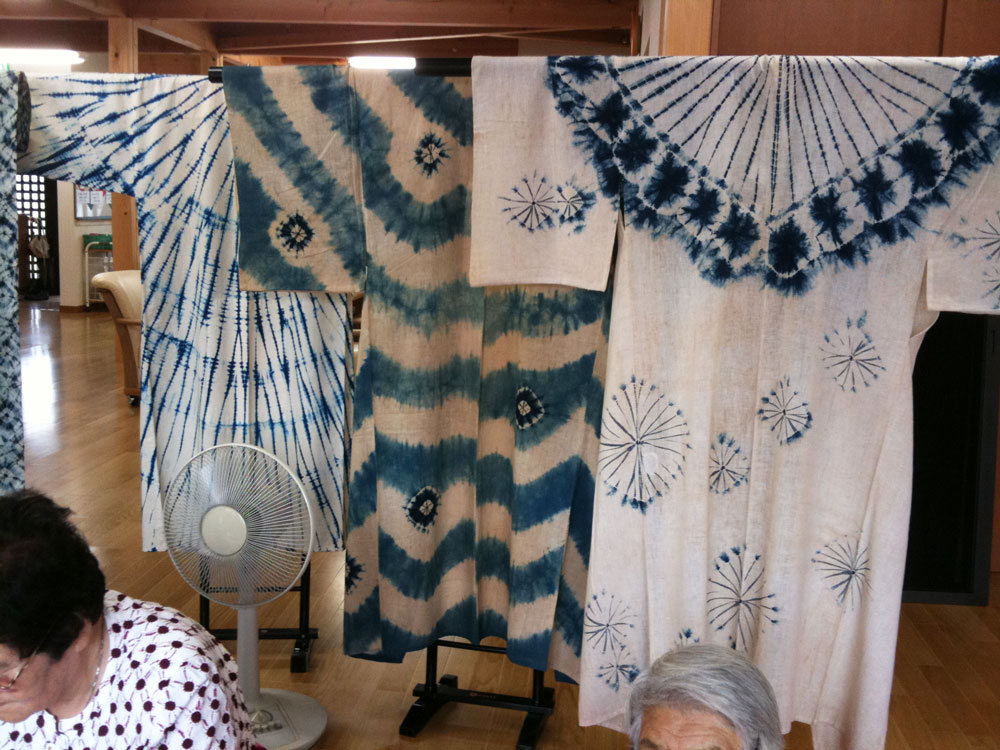
These were the show pieces being displayed at the Shibori Center where all the demonstrations were taking place. They were really gorgeous up close. 


I did say it was a hot day. I normally carry a hat, but silly me, I've left it in my luggage at the hotel so the Shibori scarf came in handy as a head scarf! With me is Shizuka Ayako's friend from Melbourne. Shizuka now lives in Hiroshima. 


I want to show you this photo of the lovely lady tying the Shibori at the speed of lightning! Can you see how my camera couldn't focus on her hand, because her hands were moving so fast! 


This little stall tucked away almost at the end of the street was the place I bought my Sakabukuro and boro pieces from. I went back to the Festival for a second day just to pick up the Sakabukuro she brought for me. I didn't have enough Japanese Yen, but she kindly accepted my Australian dollars for it. 


Here is more Shibori fabric on display at the various venues on the street.

If you ask me, was the trip to Arimatsu Shibori Festival worth it? Yes, it worth every cent I spent to get there. I cannot tell you how I felt just being there! Walking among the lovely crowd of people who love the same thing as I do 'Shibori'.  The Festival was well run and highly organized. Yes I will go back again next time I'm in Japan.  

I hope you have enjoyed reading my Japan journal so far. I'm glad I could share it with you. Reflecting on my visit in this blog freshens up my memory of everything I did there. 

I got a lovely compliment from a Japanese lady about my Japan journal. This is what she said: I read your blog.  It is well organized and it made me smile since I understood a lot.  I am very impressed the way you captured beauty of Japan. I'm so delighted to get such a compliment. 

Don't miss the next installment of my journal. It's going to be on 'shopping in Japan'....!


June 24, 2011

Silk Study Tour

Japan is still fresh in my mind! The Silk Study Tour I took at the beginning of my trip though seems further away. I spent the first 10 days of my trip with a group of ladies and a gentleman on the tour. I had a good time and met up with my friend Elizabeth Fortes whom I met in one of the online workshops. I now call her my online dating partner. I've also met two other wonderful friends, Janet Wright and Elisabeth Mclaughlin whom I hang out with on the tour. Of course there were 13 other wonderful people on the tour too. 


The tour was action packed with silk related activities. As I'm not a very technically minded person, some of the facts about silk production went straight over my head. As part of the tour we spent a day with a group of talented Japanese ladies doing natural dyeing and another session with an indigo artist Sato-San. We didn't get to dip in Sato-San's indigo vat, but we did have fun shopping at her studio.

Group photo taken at Tomioka Silk Mill. Having a group photo was one of the routines we did on the tour. The lovely lady sitting down was showing us how to reel silk from the cocoons onto a spool the way they used to do in the olden days. Please take time to visit the above link and read how an effort is being made to get the Tomioka Silk Mill listed as a World Heritage site. They need our support. 


A sack of silk cocoons at one of the factories. If I remember correctly they were naturally dyed. To think that silk yarn and fabric come from these cocoons is mind blowing! Each cocoon contains about 1000 meters of yarn.

The Japanese ladies sorting the cocoons for size and inspecting for imperfections before feeding them into the machine for reeling. I do love the look of the pure white cocoons. They are using the cocoons to make all kind of toys, key rings, mobile phone rings, Christmas ornaments etc...!

This is a complicated machine responsible for reeling the silk from the cocoons onto the spools. The process was explained to us in detail. Unfortunately it was too technical for me to share with you here correctly. 

 
Spools of silk yarn removed from the machine. The yarn is shinny and fine. This is top quality silk. 


These spools were from more modern machines. 

The presentation and a Japanese theme evening. As part of the tour a Japanese theme dinner was put on for us. We got to dress in Yukata provided by the Ryokan (Japanese Inn). The Yukata is the cotton kimono that you can wear anywhere in the Inn. It looks very smart, but be warned to remember your friends by their faces because everyone looks exactly the same wearing one of these! 

The Haori jackets were also provided by the Inn. While everyone else turned up in Yukata we opted to wear these red Haori over our black dresses instead. From left Elizabeth Fortes, Elisabeth Mclaughlin, moi and Janet Wright. I think we looked like we were ready to party! BTW, we called ourselves the 'Silk Sisters'. 

On a different night Elizabeth and I were hosting a party of our own in the room. We decorated the table using the vintage fabric we bought that day. There were always some nuts and Japanese sweets left for us in the room. We really had a fun evening. 

Of course don't forget the sake. This is only a tiny bottle of sake enough for one serve. I think we had green tea provided in the room for the rest of the evening. 

I thought I will share the back of the jacket with you. It was worn by the nice lady who showed us how to reel the silk from the cocoons in the group photo above. She patched her jacket with boro style patches. It looked cool!  

Here is the back of my boro moon jacket. I did get to wear it a few times. I got quite a bit of attention every time I wore it. It was raining that day, hence the umbrella.   

This is a giant silk wall hanging I found in the hotel's foyer. I was told that the silk was naturally dyed. I think some was indigo dyed as well. 

Our visit was mentioned in the local newspaper. I think we were at Tomioka Silk Mill when this photo was taken. Our guide translated into English for us. It was quite a thrill to be recognized by the local press in Japan. 

Thanks for reading about my trip to Japan. I try to fit each topic into one post. I will post the rest of the photos on my Flickr. I will let you know once I've done that. The following posts from my trip will cover shopping, the Shibori festival, Japanese food, natural dyes and I might fit in onsens (Japanese bath) and Japanese hospitality . Hope you enjoy reading my journal of Japan...!


Related Posts Plugin for WordPress, Blogger...